Final daily intelligence

What launched.
What matters.

Product Hunt's completed ranking, translated into practical signals for independent software builders.

12Featured launches
2,189 Votes
204 Comments
OfficialProduct Hunt rank

AI-generated inference

The day in one signal

01 / Analysis

AI-powered tools dominated Product Hunt on 2026-07-31, taking the top spot with open multimodal video generation and appearing across sales, spend management, security, robotics, and observability. Open-source and developer utilities also performed strongly, and several products emphasized privacy, auditability, and workflow-specific automation.

Artificial IntelligenceOpen SourceDeveloper ToolsSaaSAnalyticsSales & MarketingSecurityMac / System Utilities

Pattern

Trends worth noticing

  • AI is the dominant layer across multiple categories, including video generation, lead generation, AI spend tracking, deepfake detection, robotics, observability, and content generation.
  • Open-source and indie-friendly developer tools are well-represented, with mectrics, witr, TraceLLM, and Screencap reaching the daily top 11.
  • A shift from generic AI generation to workflow-specific systems: Cleanlist AI consolidates lead-gen steps, Poth Labs reasons across customer knowledge, and Screencap captures real workflows for AI training.
  • Privacy and trust are becoming key differentiators, as seen in Halo's on-device deepfake detection, DepthData's audit-labeling and 'never reads prompts' stance, and Screencap's consent and scrubbing controls.
  • Established platforms launching comprehensive updates (Customer.io Summer Release, Gemini Robotics 2) appeared alongside single-maker or small-team launches.

Builder lens

Openings for independents

  • Build workflows or plugins on top of open multimodal video models like MiniMax H3 for niche commercial content where text rendering and audio matter.
  • Create AI-native prospecting tools focused on a specific CRM, vertical, or geography, leveraging natural-language inputs and enrichment agents.
  • Extend or fork open-source monitoring tools such as mectrics or witr with paid integrations, team features, or cross-platform support.
  • Target small and mid-sized companies with lightweight AI spend and adoption trackers that emphasize simple privacy guarantees and auditability.
  • Develop privacy-preserving AI safety layers for video meetings, especially on-device deepfake detection, but prepare for integration and platform dependencies.
  • Build niche LLM observability solutions or integrations around OpenTelemetry, since TraceLLM suggests demand for standards-based AI monitoring.

Caution

Heat without enough signal

  • Deepfake detection is an adversarial arms race; false positives or negatives and meeting platform API changes can quickly undermine trust.
  • AI spend management depends on vendor APIs that may expose limited or changing data, making the 'system of record' promise hard to sustain.
  • Broad customer knowledge platforms require deep data integrations and are technically complex, exposing indie teams to high maintenance and enterprise sales risk.
  • Free and open-source system utilities can attract attention but may struggle to monetize without a clear paid tier or sponsorship model.
  • AI video generation and foundational robotics systems likely require heavy compute and face intense competition from large labs, limiting indie differentiation.
  • Any tool that records screen, keystrokes, or call content—even with consent—may face severe adoption friction due to privacy and compliance concerns.

Source data + labeled analysis

Final daily ranking

02 / Products
#1

MiniMax H3

Unified video generation for motion design and branding

Facts from Product Hunt349 votes11 comments
Design ToolsArtArtificial Intelligence
AI-generated inferencemedium confidence

MiniMax H3 is an open multimodal model that generates 2K video with native stereo sound, unifying text, image, and audio inputs for commercial content creation such as motion design and branding.

Problem signal
It appears to address the difficulty of producing high-quality commercial video content that requires accurate text rendering, visual packaging, and complex instruction following across multiple input types.
Indie angle
Because MiniMax H3 is positioned as an open multimodal model, indie developers could potentially build specialized tools or workflows for motion design, branding, and commercial content without needing to train their own video generation model.

#2

Cleanlist AI

Natural-language prospecting: find, enrich and sync leads.

Facts from Product Hunt283 votes27 comments
SalesSaaSArtificial Intelligence
AI-generated inferencemedium confidence

Cleanlist AI is a natural-language prospecting tool that turns any input—such as CSV uploads, LinkedIn URLs, domains, or search filters—into a verified, enriched, CRM-ready lead list, using AI agents to enrich contacts, verify emails, research leads, and sync the final list to a CRM.

Problem signal
GTM teams need to build targeted lead lists but currently have to stitch together multiple tools for prospecting, enrichment, verification, research, and CRM syncing, which is inefficient and time-consuming.
Indie angle
The product demonstrates that AI-native lead generation tools are viable, and indie developers could build focused alternatives for specific CRMs, niches, or regions. The use of AI agents for enrichment and research also reduces the need for complex infrastructure, allowing small teams to compete with larger incumbents.
#3

mectrics

Your Mac's vitals in the menu bar. Free and open source.

Facts from Product Hunt264 votes21 comments
MacOpen SourceMenu Bar Apps
AI-generated inferencemedium confidence

mectrics is a free, open-source macOS menu bar app that displays system vitals such as CPU, memory, battery, network, disk, GPU, temperature, and fans. Users can choose which metrics to show, and clicking an item opens detailed information. It also includes a 'Compact Health' mode that consolidates the entire machine into a single menu bar item and stays unobtrusive unless something is wrong. The app is MIT-licensed and requires macOS 15+.

Problem signal
Mac users often want to monitor system performance and health, but existing tools may be cluttered, paid, or not fully customizable. mectrics addresses this by offering a free, open-source solution that puts essential vitals directly in the menu bar with an optional compact mode that reduces noise.
Indie angle
There is potential for indie developers to build on or fork mectrics for niche use cases, or to create similar open-source monitoring tools for other platforms. The compact health concept and modular display could also inspire paid premium features or companion apps, though the current product is free.
#4

Poth Labs

The customer brain for your company

Facts from Product Hunt212 votes13 comments
Customer SuccessAnalyticsSaaS
AI-generated inferencemedium confidence

Poth Labs builds a live, relationship-based model of a company's customer knowledge, enabling an AI assistant called Ask Poth to answer cross-source questions and launch adaptive surveys when information is missing.

Problem signal
Customer knowledge is scattered across isolated documents and sources, so it is difficult to answer questions that require reasoning across everything a company knows, such as what drives churn or feature adoption.
Indie angle
There is room for an indie developer to build a focused tool that creates a 'living customer model' or AI reasoning layer for customer knowledge, especially for niche segments like early-stage SaaS teams that need grounded answers without expensive enterprise data infrastructure.
#5

DepthData

The system of record for your company's AI spend.

Facts from Product Hunt170 votes24 comments
AnalyticsSaaSArtificial Intelligence
AI-generated inferencemedium confidence

DepthData is an AI spend management and analytics platform that connects multiple AI tools—such as ChatGPT, Claude, and Copilot—into a single, audit-ready view of spend and adoption. It labels each number by how it was verified, claims it never reads prompts, and clarifies exactly what each vendor's API can and cannot expose.

Problem signal
Companies that pay for multiple AI tools often cannot answer basic questions about their AI spend: how much they are spending, who is actually using the tools, and which seats are idle.
Indie angle
There is a potential opportunity for indie developers to build focused AI spend-management tools for small and mid-sized companies that lack enterprise budgeting systems. The emphasis on privacy, verification transparency, and API-level integration could serve as a wedge into a niche where larger platforms may be less agile.
#6

Halo by Scam AI

Know who’s real on every video call

Facts from Product Hunt162 votes29 comments
MeetingsArtificial IntelligenceSecurity
AI-generated inferencemedium confidence

Halo by Scam AI is a live video-call security tool that works inside Zoom, Teams, or Google Meet and flags synthetic faces on-device so participants can tell whether the person on the call is real.

Problem signal
Deepfake video calls are already being used to scam people and businesses, and most people have no way to tell whether the person on the call is real. This creates risk in situations like hiring and wiring money.
Indie angle
The Product Hunt launch shows early demand for on-device deepfake call detection. An indie team could build a focused privacy-preserving safety layer for existing meeting apps, though this listing alone does not prove commercial traction.
#7

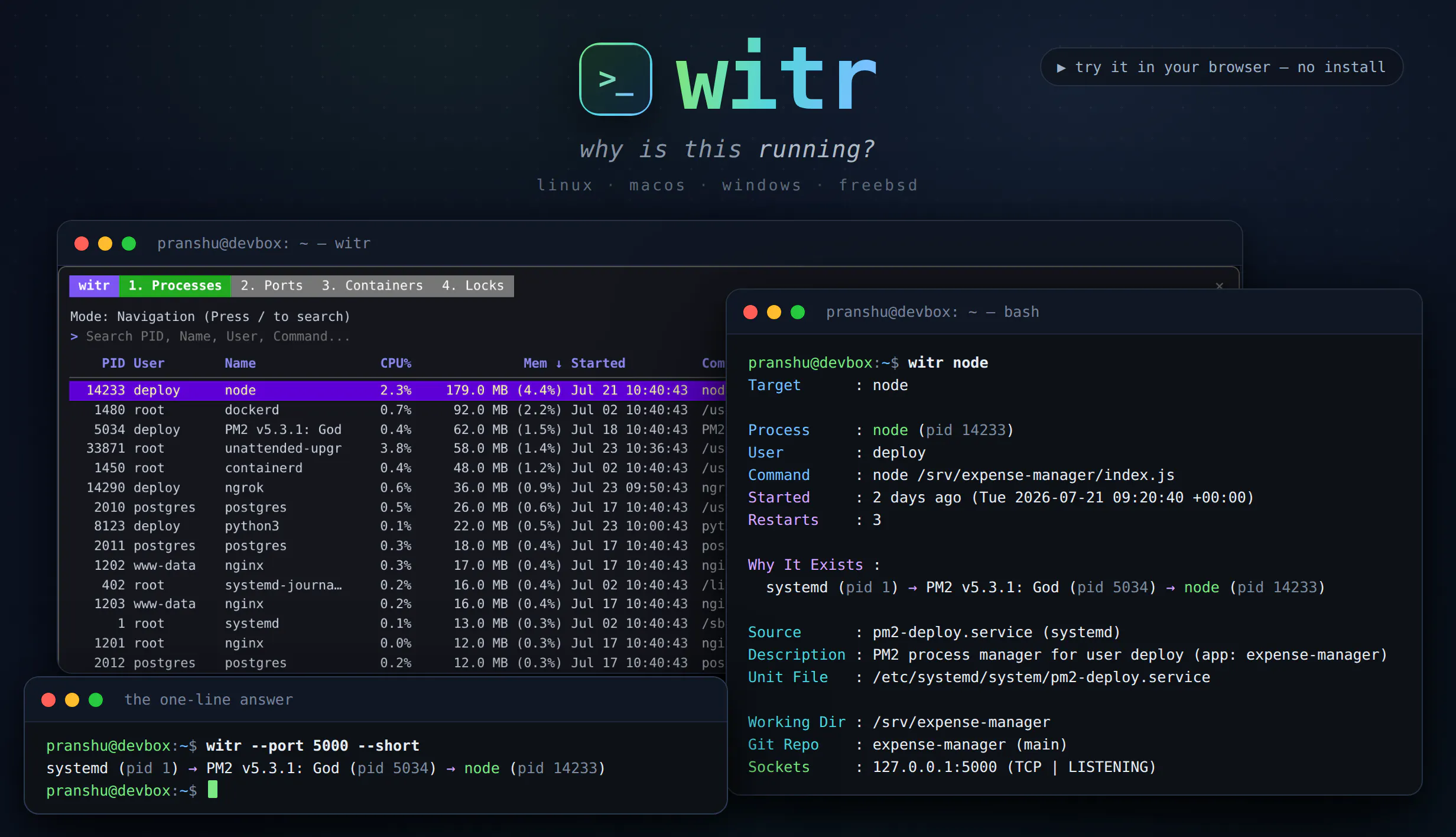
witr

Why is this running? Trace process, port, container or file

Facts from Product Hunt147 votes32 comments
LinuxOpen SourceDeveloper ToolsGitHub
AI-generated inferencemedium confidence

witr is a cross-platform developer tool that explains why a process, port, container, or file is running by tracing its origin chain (systemd, supervisor, shell, cron) and showing who started it, when, and from where. It provides an interactive TUI and scripting-friendly output modes such as --short and --json.

Problem signal
Standard tools like ps, top, and lsof show what is running but not why it is running. Developers and operators need to trace the parent chain and source of a process or resource to debug issues, understand unexpected activity, and find warnings worth knowing.
Indie angle
The product is a focused open-source-adjacent developer tool built as a single static binary, making it feasible for an indie developer to maintain and expand. Its niche—tracing process provenance across OSes beyond traditional ps/lsof—leaves room for independent tooling, automation integrations, and community-driven improvements.
#8

Customer.io Summer Release

New ways to reach customers in the moments that matter

Facts from Product Hunt140 votes3 comments
EmailEmail MarketingMarketing
AI-generated inferencemedium confidence

Customer.io's Summer Release is an expansive update to its customer engagement platform, adding new ways to reach customers via geofencing, Live Notifications, flexible SMS providers, notification inbox, WhatsApp management, and AI, all from one platform.

Problem signal
Businesses need to engage customers at the right moments across multiple channels and triggers; this release aims to address fragmented messaging by expanding triggers, surfaces, and channels.
Indie angle
The feature breadth opens potential niches for indie developers to build specialized tools, integrations, or simplified alternatives focused on specific capabilities like geofencing or notification inboxes for smaller businesses or use cases not fully served by a large platform.
#9

Screencap

Turn your team's real workflows into AI training data

Facts from Product Hunt135 votes19 comments
ProductivitySaaSArtificial Intelligence
AI-generated inferencemedium confidence

Screencap is an open-source macOS tool that records screen, clicks, keystrokes, and window context to convert real team workflows into structured datasets for AI training and automation. It enforces consent and privacy by blocking sensitive apps before recording, scrubbing traces, and requiring review before data leaves a machine. It offers a free solo trial and team pilot options.

Problem signal
Organizations building AI automation often lack structured data showing how work actually happens. Generic recording tools don't collect workflow context in a privacy-safe way, while manual process documentation is slow and inaccurate. Screencap appears to solve the gap between raw screen recording and useable AI training data by capturing real workflows with consent and privacy controls built in.
Indie angle
The product is open source with a free trial for solo use and a team pilot path, which fits an indie-friendly, bottoms-up adoption model. The niche of privacy-safe workflow-capture for AI training is still emerging, so a small team could differentiate further by building community trust through open-source transparency and expanding platform or integration support.
#10

Gemini Robotics 2

Google's AI brain for the next generation of robots

Facts from Product Hunt116 votes2 comments
RobotsArtificial Intelligence
AI-generated inferencemedium confidence

Gemini Robotics 2 is Google DeepMind's AI system for robots, powered by advanced Gemini models. It is designed to let robots understand, reason, and act in the physical world, with whole-body intelligence, dexterous manipulation, adaptive reasoning, and multi-robot collaboration across different robot forms.

Problem signal
Robots often struggle to understand, reason, and act in dynamic physical environments. Gemini Robotics 2 appears to address the need for a common AI 'brain' that can handle complex physical tasks and collaboration across diverse robot hardware.
Indie angle
Indie developers may find opportunities to build specialized applications, simulation tools, or integration layers on top of Gemini Robotics 2 once it becomes accessible. Niche robotic use cases or vertical solutions leveraging its reasoning, manipulation, and multi-robot capabilities could be promising, though access and pricing are not disclosed in the supplied facts.
#11

TraceLLM

OpenTelemetry for production AI applications

Facts from Product Hunt106 votes14 comments
Open SourceDeveloper ToolsGitHubTech
AI-generated inferencemedium confidence

TraceLLM is an observability platform for production AI applications. It monitors prompt execution, token consumption, latency, spans, errors, and model calls across LLM workflows, and exports traces using OpenTelemetry (OTLP).

Problem signal
It appears to address the lack of observability in production LLM applications, where teams need to monitor prompt execution, token usage, latency, and model calls to identify bottlenecks before they impact users.
Indie angle
Potential opportunity for indie developers is to build on or extend an open source, OTel-based LLM observability tool, especially by creating integrations with different LLM providers or self-hosted deployment options. The single-maker listing also hints that a solo developer can launch a viable developer tool in the AI observability space.
#12

Mubert API

Edit tracks & stems, get consistent music with new engine

Facts from Product Hunt105 votes9 comments
MusicAPIArtificial Intelligence
AI-generated inferencemedium confidence

Mubert API is an AI-powered API for generating and editing music tracks and stems, with real-time streaming and pipeline integration via Skills.

Problem signal
It appears to solve the problem of programmatically generating and customizing music—editing tracks, swapping stems, and maintaining consistency—especially for developers who need scalable, real-time music generation integrated into their apps or workflows.
Indie angle
Indie developers can leverage Mubert's API to add music generation and editing features to their own products without building audio models from scratch, potentially enabling niche tools such as custom music pipelines, live-streaming soundtracks, or stem-editing apps.